Tuesday, December 10, 2019

Remembering Caroll Spinney: Legendary 'Sesame Street' Puppeteer Dies at Age 85

Caroll Spinney, the legendary puppeteer behind beloved Sesame Street characters Big Bird and Oscar the Grouch, died on December 8th 2019, at age 85 at his home in Connecticut, after living with Dystonia for some time.

Spinney was born in Massachusetts on December 26, 1933 — named Caroll because he was born the day after Christmas. While serving in the U.S. Air Force after graduating high school, Spinney wrote and illustrated a comic strip about life in the military, titled Harvey. Going by his middle name, “Ed” Spinney also animated some episodes of the black-and-white cartoon series Crazy Crayon early in his working life.

The young entertainer began puppeteering in the mid-1950s, working on Rascal Rabbit out of Las Vegas before moving back to Boston, where he puppeted Goggle on The Judy and Goggle Show and performed various costumed characters for the syndicated Bozo’s Big Top. Spinney continued to work as a commercial artist and animator through the decade, and created the puppet cat characters Picklepuss and Pop.
Spinney met Jim Henson in 1962 at a puppeteering festival, and reconnected seven years later when Henson saw him perform at the Puppeteers of America festival, and sought him out. Spinney joined Sesame Street in its inaugural season in 1969.

Caroll was an artistic genius whose kind and loving view of the world helped shape and define Sesame Street from its earliest days in 1969 through five decades, and his legacy at Sesame Workshop and in the cultural firmament will be unending. His enormous talent and outsized heart were perfectly suited to playing the larger-than-life yellow bird who brought joy to generations of children and countless fans of all ages around the world, and his lovably cantankerous grouch gave us all permission to be cranky once in a while.

Welcomed to Sesame Street by Jim Henson, Caroll thrived under a mentorship that led to a decades-long great friendship. Caroll’s unparalleled career saw Big Bird visit China with Bob Hope, dance with the Rockettes, be celebrated with a U.S. postage stamp, and named a “Living Legend” by the Library of Congress.
Over his long and lauded career, Spinney has been awarded five Daytime Emmy Awards as well as a Lifetime Achievement Award from the Television Academy, with another five nominations. He has also won three Behind the Voice Awards, and was honored with a star on the Hollywood Walk of Fame in 1994.
“Before I came to Sesame Street, I didn’t feel like what I was doing was very important. Big Bird helped me find my purpose,” Spinney said in a statement announcing his retirement in 2018. “Even as I step down from my roles, I feel I will always be Big Bird. And even Oscar, once in a while! They have given me great joy, led me to my true calling — and my wonderful wife! — and created a lifetime of memories that I will cherish forever.”
Spinney performed as Big Bird and Oscar on many hit shows outside Sesame Street and Muppets projects — including Stephen Colbert, Jimmy Fallon and Jimmy Kimmel’s late-night shows, Saturday Night Live, Portlandia, Supernatural, The West Wing and the movie Night at the Museum: Battle of the Smithsonian. A favorite highlight for Caroll was conducting symphony orchestras and performing with them across the United States, Canada, Europe, Australia, China, and Japan, allowing him to personally connect with families everywhere through the music of Sesame Street, as well as voicing the characters on dozens of music albums.

He also wrote (as Oscar) the picture book How to Be a Grouch (with J. Milligan) and The Wisdom of Big Bird (and the Dark Genius of Oscar the Grouch): Lessons from a Life in Feathers. He also narrated the audiobook of Michael Davis’ Street Gang: The Complete History of Sesame Street, and was the subject of the 2014 feature documentary I Am Big Bird.
Spinney announced his retirement last October, capping his remarkable career by continuing to guide Big Bird and Oscar the Grouch through the landmark 50th season of Sesame Street, which aired this year.

Caroll Spinney gave something truly special to the world. With deepest admiration, Sesame Workshop is proud to carry his memory – and his beloved characters – into the future. Our hearts go out to Caroll’s beloved wife, Debra, and all of his children and grandchildren.
Sesame Street co-founder Joan Ganz Cooney said of her longtime colleague and friend, “Caroll Spinney’s contributions to Sesame Street are countless. He not only gave us Big Bird and Oscar the Grouch, he gave so much of himself as well. We at Sesame Workshop mourn his passing and feel an immense gratitude for all he has given to Sesame Street and to children around the world.”

Frank Oz

Noel MacNeal

Steve Whitmire
Matt Vogel
Stephanie D'Abruzzo

Leslie Carrara-Rudolph


Ryan Dillon
Bob McGrath

Emilio Delgado

Sonia Manzano

Alan Muraoka


Chris Knowings

Suki Lopez
Norman Stiles

Mo Willems

Elizabeth "Liz" Hara

Michael Schupbach

David Stephens

Louis Henry Mitchell

Ozzie Alfonso

Andrew Moriarty
Tarah Schaeffer


Nitya Vidyasagar
Violet Tinnirello
Frankie Cordero
Tim Lagasse
John Tartaglia
Warrick Brownlow-Pike


💛 Caroll Spinney, the legendary puppeteer behind beloved Sesame Street characters Big Bird and Oscar the Grouch, died today, December 8th 2019, at age 85 at his home in Connecticut, after living with Dystonia for some time. Since 1969, Caroll’s kind and loving view of the world helped shape and define Sesame Street. His enormous talent and outsized heart were perfectly suited to playing the larger-than-life yellow bird who brought joy to countless fans of all ages around the world, and his lovably cantankerous grouch gave us all permission to be cranky once in a while. In these characters, Caroll Spinney gave something truly special to the world. With deepest admiration, Sesame Workshop is proud to carry his legacy – and his beloved characters – into the future. Our hearts go out to his beloved wife, Debra, and all of his children and grandchildren. We will miss him dearly. #CarollSpinney #BigBird #SesameStreet Repost from @sesamestreet 📸: @richardtermine
A post shared by Warrick Brownlow-Pike (@warrickbp) on


Louise Gold

Tyler Bunch


A post shared by Tyler Bunch (@tylerthebunch) on
Stacey Gordon

Julianne Buescher


A post shared by Julianne Buescher (@juliannebuescher) on
Craig Shermin

Jan Nelson

Sherrie Rollins Westin

Jim Henson Company
Jim Henson Foundation

The Jim Henson Legacy
The Muppets

Puppeteers of America

Center for Puppetry Arts
"We are deeply saddened by the death of Caroll Spinney, the talented puppeteer behind beloved characters such as Big Bird & Oscar. He will be missed."


Museum of the Moving Image
We're very sad to hear about the death of Carroll Spinney, the performer behind the childlike Big Bird and the cantankerous Oscar the Grouch—both beloved Sesame Street characters, and part of the world of Jim Henson. Rest in Peace.
This photo of Carroll with his wife Debra and Jim Henson Legacy President Craig Shemin was taken in 2015 at the Museum
#carrollspinney #bigbird #oscarthegrouch #sesame50 #hensonmomi
Ballard Institute & Museum of Puppetry

Hilary Clinton
Michelle Obama

Saturday, August 25, 2018

Hotel Transylvania 3: Summer Vacation - Movie Review

Recently, I saw Hotel Transylvania 3. Before I review this film, I feel like I should talk about the other two. When Hotel Transylvania was released, critics gave lukewarm reviews; Hotel Transylvania 2 didn't get the best reviews either. Honestly, I don't know why. I absolutely loved them. I think they're hilarious, beautifully animated and creative; the characters are great and the comedy is super fast. They're not groundbreaking, but as straight-forward Halloween comedies go, I think they're insanely funny and I enjoyed them.
The film is once again directed by Genndy Tartakovsky, who directed the previous two and, for the first time in the series, has taken a screenwriting credit with Michael McCullers. He is a brilliant animation director and one of my favorites, best known for creating Dexter's Laboratory and Samurai Jack (he recently finished season 5 which I thought was masterful). I love his timing and editing; I've always appreciated his work. Hotel Transylvania 3: Summer Vacation is filled with visual inventiveness, creative character designs, good jokes, funny sequences and tons of adult humor. Just like the previous two, there's a lot of jokes that kids are not going to understand; this film has even more adult humor than the last, which I appreciated.
As far as storytelling goes, it's going to be very obvious from the beginning. This movie was a bit too much for me as in it was too much where it needed less and it wasn’t enough where it needed more. There's really no surprises. In fact, the plot is so basic I feel the main plot of this movie is five pages of script. It is different than the other two because it takes place on a cruise ship, so you have a new environment with new things that you can do. So, it does feel like its own thing compared to the others. This movie attempted to be fun and it was, but to the point of being exhausting. The jokes in this movie get old pretty fast; it just felt repetitive. One of the advantages of these movies is that if a joke doesn't work, they quickly move on to the next one. Some of the jokes were not hitting and I didn’t feel like it was fluid with the plot. I think a big part of that is the jokes didn't seem as character-driven. They have so many characters now. Johnny is pointless throughout the film, until the end. You forget he's there and he was a major part of the first two movies. Some of the other characters almost kind of blend together. Frank, The Mummy and The Invisible Man almost seem like one character now. They're all there to make some jokes work or not work. It’s more fast-paced because it does feel like a series of jokes and that could be a negative because you wonder where's the story going. There isn't that much under the surface and that's fine. I don't think that every animated film has to be mind-blowingly deep; some are just meant to teach kids a lesson, while also entertaining them.
As someone who loves animation, this film feels different than your average animation nowadays like Pixar. Incredibles 2 feels like a film, an experience. The Hotel Transylvania movies feel like cartoons and I mean that as a positive; this could be because of Tartakovsky's background with Cartoon Network. You can enjoy the characters and have fun laughing at their situations, but in particular it's the character design and visual creativeness with every monster. There's an early sequence on an airplane run by a bunch of gremlins, Gremlin Airlines. There's a lot of great moments like that which has a hidden message in there because, just like the other two, the underlying moral of the film is that humans and monsters can co-exist; you're allowed to look at someone else who might be different from you and appreciate them for who they are. That's something kids are going to take away from and hopefully apply to their own life.
What I loved about the first two films is although the animation is fun and it did have a lot of energy to it, every character had a distinct kind of movement. In the first movie, if you compare how some of the characters move: Dracula is very proper, upright and usually the upper half of his body is not doing much, but his lower half is doing something; Mavis is feminine, sleek and smooth; Frank is very big, so he'll move very grand and huge; and The Mummy is more round, so he'll move with more curves. I think these movies have this way where characters will suddenly move very quickly. In the first two films, it was balanced just enough. In this film, every character moves like that all the time and they all move the same. You’re thinking not everyone needs to be doing something. Calm down, stop, take a breath! It's very distracting when you just want to hear a joke and focus on what they're saying.
They introduce Erika, a new character who is the descendant of Van Helsing, which is a funny idea, and even she moves like everyone else. I think one of the things that really drew me to the other films is that even though they're not phenomenally character-driven, that's still the focus. I think that's surprisingly what made a lot of those jokes work in the first two films. Even though not all of them work, it's still what gave it its charm and I think that's what's missing here. A lot of the charm is gone and it's not replaced with comedy funny enough to fill that void.
There are still a few emotional moments where it can slow down. I like this idea that Dracula is feeling lonely and looking for someone else to be with. You see him try to go on a date and be nice, but the person he's trying to date is trying to kill him; this is a great idea. I like those moments, but there's not many and a lot of it is replaced with generic slapstick that sometimes works. Sometimes they'll throw in a little surreal humor. When Dennis and Winnie (Mavis and Johnny's son and his werewolf friend who I feel are very underutilized) are trying to sneak in his gigantic pet dog, they have him in a big coat and hat. They say, "This is Bob. Say 'Hi Bob.'" The dog suddenly goes "Hi Bob" and walks in. You have no idea how that's possible. Jokes like that are great and there are a couple, but it's very half and half. When they don't work, it's not awful; you're just really wishing it worked because it worked so well in the other two films.
The thing I actually liked the most above the animation is the basic message of monsters may look different from us, but it doesn’t mean they’re not the same. This movie makes an attempt to go a little deeper. I’m not saying they go full ending or anything, but this movie delved into an angle of how it exists. I thought that was really gutsy and impressive where most movies just stop at the fact of the matter addressing that prejudices exist. Anyway, I’m not saying there’s the way, this one thing that happens that causes prejudice, but I liked how it showed how they have a tendency to get passed down. 
The climax, which is suppose to be the big moment in the movie, has this musical setup where they have to use songs against each other. Dracula and Johnny need a positive song and they're playing all sorts of different songs. They say we really need something happy, an incredible beat to defeat the evil negativity. What's so funny is that there's so many other songs you can choose because they built it up so much that this one song could probably get a laugh. The song they choose is baffling; I'm amazed they went with this because not only is it old, it's not even old in a retro way. I guess it was kind of trying to replicate Jim Carrey’s “Cuban Pete” sequence from The Mask. Another good example is when Catherine O’Hara and the other guests sing Harry Belafonte’s “Day-O” in Beetlejuice. It's already a timeless song that it gets a laugh; it's just so bizarre and out of nowhere, it rides the strangeness of it. Here, it's not weird, relevant or funny enough; it's the most awkward song you can choose. However, while critics will likely jump, at least this movie goes for it; it really puts everything out there and blows up with this crazy sequence. 
I had a weird reaction towards the big finale. At first, I was scratching my head, thinking "Are they really doing this? They are. I guess they're going for it.” In the end, I was cringing, thinking “Who made that choice?,” but had this feeling inside that it kind of won me over. I heard one half of the audience I saw it with, a lot of children, laughing and having a good time. The other half wasn’t feeling it or getting into it. So, was the climax good or bad? I’ll let you be the judge. I think that’s the divide between critics who go to this film and want to express whether or not they were entertained by it, but in the long run it is really made for families.
I'm still glad I saw this and I don't regret seeing it because I like showing support for these movies, especially when other critics don't for whatever reason. There's still a few jokes that work; one that only adults can appreciate is Wayne and Wanda (the Wolf Man and his wife), whose children are constantly on them. They never get any free time. When they find a daycare on the ship, Wayne is like "You'll take our kids, on purpose?" A lot of parents in the audience laughed at that and the kids were silent, but that's a joke entirely for the parents. So, the werewolves drop off the kids and you see what they do in their spare time; they're just so not used to not having kids and they've never had that before. Stuff like that is great and that comes from their character; I think that's where that works. Any of the jokes that come directly from the characters I think are usually pretty solid; any jokes around the monster stuff is okay, but a lot of generic slapstick didn't hit.
If you like the first two films and are curious enough that you know it's not going to be that hot, but you like its world and characters, I still say go check it out. It's not super bad or offensive and there's nothing ethically bad in it. You can take your kids to see it. There’s a lot of goofy stuff, too much slapstick honestly; it doesn't really balance out. Hotel Transylvania 3 isn't going to go down as an animation classic nor will the first two, but this series is a fun enough cartoon that adults can enjoy as well as kids. Overall, you'll get enough laughs out of this.
There is something that animations do commonly: when someone gets beaten up, their wounds disappear seconds later because it's a cartoon. There's a scene where Dracula gets a hundred arrows in his body, an axe in his head and snakes biting his arm. I kept waiting for them to disappear, but they remain on him for the entirety of the rest of the scene and it got so hilarious that they weren't going away. Tartakovsky is playing with animation tropes and that's something that he does so differently than your average animation director. I want to see more from him. After completing Hotel Transylvania 2, he was working on two different projects: an original concept called “Can You Imagine?” and a Popeye film. Now, he’s working on two newer projects: Fixed, an R-rated comedy, and Black Knight, an epic action-adventure film. I'm hoping to see these get green-lit.

Wednesday, August 15, 2018

The Incredibles 2 - Movie Review


I loved the first Incredibles film; it was impressive since it was Pixar's first film with all human characters. I remember when Pixar was making these sequels (Cars 2 and 3, Monsters University), I was thinking to myself, "Why aren't they making Incredibles 2 or Ratatouille 2?" (At least I got some relief from Finding Dory.) Writer-director Brad Bird has stated for many years that he would only make it if he felt that it could be as good as the first. And I respect him for that. He has made some of the greatest and fantastic animated films ever: The Iron Giant, The Incredibles, Ratatouille, and now this!
I loved this film; it was so good. This was an extremely exciting, well-made, awesome, entertaining and fun movie, accompanied by Michael Giacchino's score. One of my favorite things about Brad Bird's animated films is that they are intelligent. They never pander to children or treat them as if they're stupid.
Some of my favorite scenes are Bob Parr trying to take care of Jack-Jack and discovering what his powers are because one of the messages in the film is that being a superhero is not just fighting crime. Being a parent, raising children, being a family; that's just as heroic. Plus, they weren't trying to make him look like he's an idiot. It's not just a role-reversal plot cliche; it's more than that. 
There's a conversation where Elastigirl is talking to another character about superheroes and the law and politics surrounding them and it's an actual debate. This is the kind of thing where a kid might doze off, but, as an adult, I was enthralled watching this.
The animation is stunning and animators don't get enough credit. The action sequences are amazing and really shine. There's a sequence with a character named Void that can create portals and send things through them and transport them. She's trying to get Elastigirl up to a flying plane and they keep missing and have to try again. There's a sequence with a train that's going in reverse and Elastigirl has to use her abilities to get it to stop. There's a sequence where she's breaking into an apartment and the lighting feels like a dark, suspenseful drama and not like a kid's film.
The returning cast (Craig T. Nelson, Holly Hunter, Sarah Vowell and Samuel L. Jackson) makes these characters real, identifiable and likable. 
My biggest problem was I found the villain character both cliche and obvious; the setup was very weak and the motivation made no sense. There were no surprises for me. Syndrome, the villain from the first film, was much better. Granted, his motivation was pathetic and ridiculous, but that's the charm of it and matches the character, which makes it great. He also had this philosophy he was going for (the idea that if everyone's special, that means no one is), which is a very teachable moment. This movie was trying to be more serious than the first one, but the villain doesn't have a moment like that.
My other complaint is: although both films had great editing, they're also too long. However, because I'm such a huge Brad Bird fan, I don't care. I feel the audience won't mind either because they'll be too busy having a good time. I highly recommend this movie.
There's also an epic battle scene between Jack-Jack and a raccoon; not only is it brilliantly animated, but every gag hits bulls-eye. It's like Tom and Jerry-level classic slapstick.

Friday, June 8, 2018

Highlander Newspaper comic: Art and Jimmy #2

My last college year is almost finished. I'm going to be graduating in about two weeks.
This is my second Art and Jimmy comic that got published in my college newspaper, the Highlander. I'd like to take this moment to say thank you to all of my colleagues at the Highlander Newspaper.


https://highlandernews.org/33465/33465/

Courtesy of the Highlander newspaper from UC Riverside

Friday, May 11, 2018

Highlander Newspaper comic: Art and Jimmy

Sorry, I haven't posted in a while. I'm finishing up my last year in college. However, I still have a lot of stuff to post here and I'm working on new projects (one of which I'm posting now). Here is a comic strip that got posted in my college newspaper called Art and Jimmy.


https://highlandernews.org/33057/art-and-jimmy/

Courtesy of the Highlander Newspaper from UC Riverside

Thursday, July 27, 2017

Remembering June Foray, Legendary Voice Of Rocket J. Squirrel and Natasha Fatale & Annie Awards Founder, Dead At 99


Moose and Squirrel of ‘Rocky and Bullwinkle’ fame. An entire generation never tired of watching Bullwinkle try to pull a rabbit out of his hat.
Today all of Toon Town mourns. Voice acting legend June Foray, widely known to generations of cartoon lovers as the First Lady of Voice Acting and the driving inspiration behind animation’s biggest night, The Annie Awards, died today at the age of 99. She was indomitable and seemingly indestructible, working into her 90s and winning an Emmy award in the midst of her 9th decade. Accepting the reality of her death will take some time.
The news was confirmed and made public on Facebook by a longtime close family friend, Dave Nimitz, writing, “With a heavy heart...I want to let you all know that we lost our little June today at 99 years old.” The cause of death is still to be announced. Foray would have celebrated her 100th birthday on September 18.

June Foray at the Hollywood
premiere of Warner Bros. feature
‘Happy Feet Two’ in 2011.
ASIFA-Hollywood president Jerry Beck also shared the news, “On behalf of ASIFA-Hollywood, which June was a founder of, we are mourning the passing of animation’s best friend,” in a statement posted to Facebook Thursday night. “She has touched so many lives -- her voice was so many classic cartoon characters -- her efforts to create ASIFA, to maintain the Academy’s Oscar for Best Animated Short -- and her leadership in crafting the category of Best Animated Feature. She was one of a kind. A trail blazer, a great talent and a truly wonderful person. We will never forget her.”

June Foray (the early years).
Foray’s long career in animation began when the Walt Disney studio approached her to play Lucifer the cat in Cinderella, which led to a series of gigs with the studio — mostly uncredited. She had a starring role in the 1952 Donald Duck short Trick or Treat as Hazel the Witch, a name and occupation combination that would prove quite popular in her character roster. Through the 1950s, Foray also worked with animation icons Tex Avery, Walter Lantz and Chuck Jones. Her best known work was in Jay Ward’s The Rocky and Bullwinkle Show, which ran from 1959 to 1964, playing Rocket J. Squirrel and Russian minx Natasha Fatale. Foray also worked on other Ward toons, playing Nell in Dudley Do-Right, Jane in George of the Jungle and Marigold in Tom Slick.
June is surrounded by stellar talents in this 1995 shot: Stan Freberg, with whom she worked so memorably on comedy records and radio, and longtime friends Ray Bradbury and Norman Corwin. It’s hard to believe they’re all gone now.
Born June Lucille Forer in Springfield, Massachusetts, Foray was 12 years old when she landed her first job in a local radio drama, and by the age of 15 was doing regular radio voice work when her family relocated to Los Angeles — in addition to frequent appearances on popular shows, she had her own Lady Make Believe show. Foray also worked at Capitol Records making children’s albums and comedy records.

Foray voiced countless other characters in Looney Tunes and Hanna-Barbera cartoons. Her hundreds of acting credits include other popular characters like Jokey Smurf and Mother Magoo in the Mister Magoo series. She also lent her voice to the iconic “Chatty Cathy” doll, and later voiced the demonic doll Talky Tina in the “Living Doll” episode of The Twilight Zone in 1963. Continuing to work well into her 90s, the leading lady of animation reprised her classic roles and took on fresh challenges for a range of projects like The Marvelous Misadventures of Flapjack.

She was one of the leading voice actresses of the Golden Age of Hollywood theatrical animation, and later transitioned to television series, commercials, movie dubbing, and narration, with a career that lasted into the current decade. Among the hundreds of cartoon characters she brought to life, her iconic roles included Rocky the Flying Squirrel and the villainous Natasha Fatale in The Rocky and Bullwinkle Show and its spinoff Boris and Natasha, Witch Hazel (who first appeared in Chuck Jones' 1956 cartoon "Broom-Stick Bunny") and Granny in the Looney Tunes theatrical shorts, Nell Fenwick in The Dudley Do-Right Show, Ursula in George of the Jungle, Lucifer the Cat in Disney’s Cinderella, Cindy Lou Who in How the Grinch Stole Christmas!, Ma Beagle and Magica De Spell in Ducktales, and Grammi Gummi in Adventures of the Gummi Bears. June loved what she did and loved to work, even if she didn’t always get credit. She dubbed telephone operators and other incidental voices in Steven Spielberg’s Jaws, among many other feature films.

Foray also voiced several roles in feature films, including a mermaid in Peter Pan, Grandmother Fa in Disney’s Mulan, and Wheezy and Lena Hyena in Who Framed Roger Rabbit, in addition to reprising her roles as Witch Hazel and Granny in the 1996 Warner Bros. hybrid feature Space Jam.

She worked well into the 21st century, reprising her role as Rocky in 2000’s The Adventures of Rocky & Bullwinkle and the 2014 DreamWorks Animation short film directed by Gary Trousdale. Her performance as Mrs. Cauldron on The Garfield Show earned her a Daytime Emmy in 2012, and she was awarded the TV Academy’s prestigious Governor’s Award in 2013. Her many achievements have also been marked with a Walk of Fame star and a Hall of Fame Award from the World Animation & VFX Summit. A documentary about her life and career, The One and Only June Foray was released in 2013.
Her prolific body of work as a voice actor often drew comparisons to her colleague Mel Blanc, but animation director Chuck Jones set the record straight once when he said, “June Foray is not the female Mel Blanc. Mel Blanc is the male June Foray.” What her many fans may not know is that she chaired the short subject branch of the Academy of Motion Picture Arts and Sciences for many years, and fought tooth-and-nail to keep animated shorts a part of the annual Oscar broadcast. Though she was diminutive in size, she stood her ground year after year. Animators will forever be in her debt.

I’ll update this post over the next few days as remembrances, tributes, and obits become available. In the meantime, to learn more about her life and work, I recommend picking up her autobiography Did You Grow Up with Me, Too?

You can watch an in-depth Archive of American Television interview with Foray about her voice acting career here.

Watch Foray discuss voicing Rocky and Natasha on The Bullwinkle Show in the video player below:
The longevity and range of June Foray’s career in animation is legendary, but what also shouldn’t be overlooked is her tireless and selfless boosterism of the animation art form. In addition to her career as a performer, Foray played a key role in the animation industry as one of the founders of ASIFA-Hollywood, and when she was president of the organization in the 1970s, she started the Annie Awards, an event which recognizes achievement in animation, that will celebrate its 45th anniversary next year. I loved her many voices, including the raspy old-lady she often did in Jay Ward’s Fractured Fairy Tales. She revealed one day that it was a parody of character actress Marjorie Marin—which made perfect sense once she pointed it out. She also played a more benign Granny in Warner Bros.’ Tweety and Sylvester cartoons.

Foray was an avid supporter of the medium and worked tirelessly to have animated films recognized by the Academy of Motion Picture Arts & Sciences. She had been working in animation for about 20 years when the casual group that would eventually become ASIFA began to set up. ASIFA West Coast was founded in the 1960s, comprised of Foray, Carl Bell, Les Goldman, Herbert Kasower, Ward Kimball and Bill Littlejohn. Beginning as a small dinner event in 1972, The Annies grew into the annual gala recognizing top talent in animation that continues to this day. “I was thinking that there were the Grammys, the Tonys, the Oscars, but nobody recognizes animation,” she said in an interview with Variety. The first event gathered some 400 attendees to honor Max and Dave Fleischer. In 1995, the Annies created a juried award named after Foray, which was established to recognize individuals who have made significant and benevolent contributions or charitable impact to the art and industry of animation, and she was its first recipient.

Further, the reason the Academy of Motion Picture Arts & Sciences has an animated feature Oscar category is due in no small part to her decades-long lobbying effort. She was on the Academy’s board of governors for 26 years, and spent the majority of those years pushing to have the Academy recognize feature animation, which they finally did in 2001 when the first award was bestowed on DreamWorks Animation's Shrek. June represents the best of a golden era of animation—not to mention radio and comedy records, where she also left an indelible mark. (This would be a perfect time to listen to Stan Freberg’s “St. George and the Dragonet” and “Little Blue Riding Hood.”)
Three of the great vocal talents of our time: Jeanette Nolan, Janet Waldo, and June Foray, at a luncheon given by Bob Ahmanson in 1995.
Foray advocated for animation to be taken seriously as an art form long before such thoughts had entered mainstream consciousness. “Animation has come out of its adolescence,” she told The Los Angeles Times back in 1965. “It has grown into a medium for adults…Along with this is the fact that animation has become an art form. It has become an industry filled with people who at one time would have become painters, sculptors, writers for other fields. Animation once was considered a stepchild of the motion picture industry. It has become an industry in its own right.” She was a great talent and, as anyone who knew her can testify, a force of nature. She deeply cared about animation and devoted herself to promoting the medium.

This year, as we get set to begin our annual coverage of awards season, it’s worth remembering that a big reason we even have so much attention directed toward animation nowadays is due to the efforts of a single remarkable woman, the one and only June Foray. Farewell, Rocky… Adios, Natasha… we’ll never forget you or the woman who gave you life.

Rest In Peace, June Foray. Your spirit, kindness and wit are greatly missed.
June Foray at a Warner Bros. recording session with Chuck Jones (left) and Mel Blanc, ca. mid-1950s.
June Foray recording “St. George and the Dragonet” with, from left, Walter Schumann, Daws Butler, and Stan Freberg, 1953.
June Foray with San Diego Comic-Con founder Shel Dorf, 1973.
June Foray dancing (center) at a Format Films holiday party, ca. early-1960s.
June Foray with (l. to r.) Tex Avery, Chuck Jones, Friz Freleng, and Art Babbitt at the 3rd Annie Awards ceremony, 1974.
In addition to her voice acting, Foray was one of the mermaid models in Disney’s “Peter Pan.” In this photo, Foray is on the right.)
June Foray collage courtesy of Everett Peck via Facebook

Friday, January 6, 2017

Tyrus Wong (1910-2016), ‘Bambi’ Production Designer and Artist and Disney Legend, Dies at 106

Tyrus Wong, a Chinese-American painter, printmaker, calligrapher, illustrator, and kitemaker and Hollywood production artist and designer, who was one of the most celebrated artists in US history and most notable for being the delicate driving force behind the production design that inspired Walt Disney’s feature Bambi (1942), has passed away last week at the age of 106. A Disney inspirational sketch artist from 1938 through 41 – and later a career film production illustrator for Warner Bros. from 1942 through 1968 – Wong's work establishing the spare, haunting visual feel of Bambi served as the blueprint for the artistic stylings and was essential to its success as a work of art, yet passed much of his career unknown to the general public. Wong’s contributions to the animated classic were largely unrecognized until half a century after the film arrived in theaters, where critics and filmgoers were struck by its haunting, painterly visuals. Wong was inducted as a Disney Legend in 2001, and received a Historymakers Award for art from the Chinese American Museum.
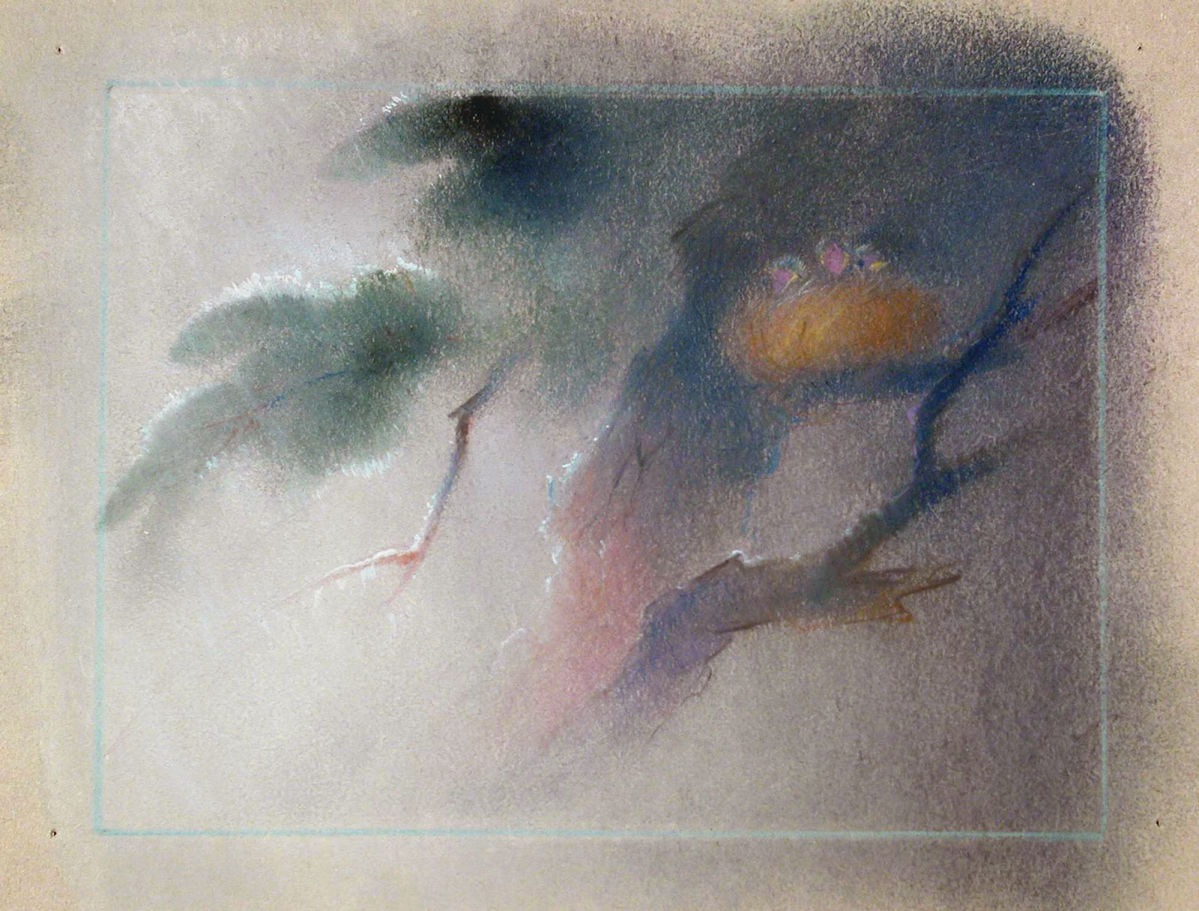
Legendary Disney artist, Tyrus Wong had a gift for evoking incredible feeling in his art with simple, gestural composition; his influence on the artistic composition of the animated feature Bambi cannot be overstated. Wong had a brief career in animation, working at The Walt Disney Studios only three years, between 1938 and 1941, but made an outsized contribution to animation history with his innovative production design of Bambi. He was working as an entry-level inbetweener, drawing hundreds of sketches of Mickey Mouse to fill in the gaps separating key pose to key pose, at Disney when he showed art director Tom Codrick his atmospheric pastel ideas for Bambi, that provided a solution to Bambi’s backgrounds by suggesting the atmosphere of a forest without describing every leaf and branch.
Codrick showed them to Walt Disney, who was equally excited by the approach. “Looks like we put you in the wrong department,” Codrick told the young artist. Wong was immediately offered the opportunity to “color key the whole picture from beginning to end, to make a painting that sets the mood” of the entire production.

Wong received credit on the final film only as a background painter, but wasn’t recognized for his role as the production designer of the film until many years later. Despite the low pay he received, Wong stayed inside the studio with all the veteran artists during the 1941 strike—”I was being a good boy”—but that didn’t matter. He was let go from the studio a year before Bambi was released. “I don’t feel bitter toward Disney at all, except for a few guys who I know to this day kinda resent me,” he told historian John Canemaker.
Reflecting on his work on Bambi, Wong said, “The script would say, ‘Early morning: the deer goes out onto the meadow.’ I would try to create the atmosphere of that meadow, the fog on it and so forth . . . mood sketches. My painting has always been very poetic—that’s the Chinese influence. In Chinese art, the poet is a painter and the painter is a poet. The object isn’t to reproduce photographic reality, as it is in Western painting, but to capture a feeling.”
Wong himself considered animation to be “a minor, very small part” of his artistic life, which also included twenty-six years as a live-action production designer at Warner Bros. (and other studios) where he worked on renowned, classic films like The Sands of Iwo Jima (1949), Rebel Without a Cause (1955), Around the World in Eighty Days, and The Wild Bunch (1969). He also continued his long art career in a variety of mediums as a greeting card designer, and in his spare time, created murals, toys, ceramics, lithographs, and kites.

“Trained as a painter, Mr. Wong was a leading figure in the Modernist movement that flourished in California between the first and second World Wars. In 1932 and again in 1934, his work was included in group shows at the Art Institute of Chicago that also featured Picasso, Matisse and Paul Klee,” as the New York Times writes:

As a staff artist for Hollywood studios from the 1930s to the 1960s, he drew storyboards and made vibrant paintings, as detailed as any architectural illustrations, that helped the director envision each scene before it was shot. Over the years his work informed the look of animated pictures for Disney and live-action films for Warner Brothers and other studios, among them “The Sands of Iwo Jima” (1949), “Rebel Without a Cause” (1955) and “The Wild Bunch” (1969). But of the dozens of films on which he worked, it was for “Bambi” that Mr. Wong was — belatedly — most renowned.
A production design painting that Wong produced for the Warner Bros. film “The Wild Bunch” (1969).
Born Wong Gen Yeo on October 25, 1910, in a farming village in Guangzhou (Canton), Guangdong Province, China, Wong was a gifted artist who exhibited a love of painting and drawing at a young age. Wong came to the United States in 1920 at the age of 9 in hopes of economic opportunity, where he lived with his father, a laborer — leaving his mother and sister behind, never to see them again. Upon arriving in California, father and son travelled under false identities in order to take advantage of a loophole in the immigration laws created by the 1906 San Francisco earthquake and fire and were held and became separated at Angel Island due to the Chinese Exclusion Act (1882-1943). After enduring the immigration process — which often included lengthy interrogations — they lived in Sacramento before moving to Los Angeles. 

Tyrus Wong in 2013 with one of his fantastical kites.
At the time, the thought of a Chinese American being a professional artist was almost unheard of. And yet amidst working as a houseboy, a janitor, and later a busboy, Tyrus forged on. The artistic spark began when Wong’s father encouraged him to practice calligraphy every night by dipping his brushes in water and “painting” on newspaper, but they were so poor that they couldn’t afford ink. “We can’t afford ink or rice paper,” Wong once said. “But he made me do it with water. That’s a good training.” The fleeting nature of the drawings helped inform Tyrus’ style—one in which minimal brush strokes are used to evoke worlds of emotion and feeling.

As a junior high student, Wong’s talent was evident to his teachers, who along with his father encouraged him to pursue art. He received a full-time summer scholarship to Otis Art Institute in Los Angeles, working while pursuing his education.

When his scholarship ended Wong decided to pursue an art career full-time, and his father somehow managed to scrape up the then-$90 tuition to let him stay on as Otis’s youngest student. He studied there for at least five years, simultaneously working as the school janitor, before graduating in the 1930s. Not long afterward his father died, leaving Wong entirely on his own.

After graduating, Wong put his gifts and training to use in Hollywood. From 1936 to 1938, Wong worked as an artist for the Works Progress Administration, creating paintings for libraries and other public spaces. Newly married, Wong said he “needed a job.” It was at that time he began the Disney studio in 1938 at first as an “in-betweener” on Mickey Mouse shorts, in which artists were creating thousands of intermediate drawings that bring animated sequences to life. When he heard that the studio was in pre-production on adapting Felix Salten's Bambi, a Life in the Woods, he went home and painted several pictures of a deer in a forest and soon submitted his own landscape paintings as an audition for a job in that production. The small, but evocative sketches and background paintings captured the attention of Walt Disney and became the basis for the film’s visual style.
While the backgrounds in Snow White were incredibly detailed, Disney was struck by Wong’s ability to create lush, impressionistic backgrounds that sing with color, minimalistic brush strokes, and feeling. “His styling made it different from any other Disney film … you feel the dampness and moisture of everything in the forest, but you didn’t draw every single leaf–they were beautiful,” recalled Marc Davis, one of Disney’s Nine Old Men. Composed of Disney’s core group of animators, the Nine Old Men helped bring some of Disney’s most celebrated works, from Snow White to The Rescuers to life. Walt had the 28-year-old Wong begin working on Bambi later that same year and he was unofficially promoted to the rank of concept artist, helping to influence the film's music, coloring, special effects, and more. Walt Disney saw that Tyrus was able to produce exquisite artwork that did not necessarily look like the forest—but rather, felt like the forest. Walt’s vision for Bambi and use of Tyrus’ work still influences films today. 
Wong spent two years painting the inspirational illustrations that would inform every aspect of Bambi, and throughout the finished film his influence is unmistakable. But Wong was fired in the wake of the bitter 1941 artists strike.

From Disney, Wong next joined nearby Warner Bros., in 1942, working as a concept and story artist, designing sets and storyboarding sequences for the next 26 years until his retirement in 1968. He became a United States citizen in 1946, the same year he made a name for himself as a distinctive designer of Christmas cards for Hallmark – and painted elegant Asian-inflected designs on what is now highly-collectable dinnerware, highly sought after by collectors. Living with his wife in Sunland, CA, Wong became in retirement a renowned kitemaker, designing and building astonishing hand-made creations up to 100 feet long.
In the final decades of his life, Wong received significant attention, starting with a chapter in John Canemaker’s book Before the Animation Begins (1996). In 2001, in formal recognition of his influence on Bambi, Wong was named a Disney Legend, an honor bestowed by the Walt Disney Company for outstanding contributions, and his work has continued to inspire and influence the leading animators of today. A retrospective of Wong’s work was the inaugural exhibition of the Chinese American Museum in Los Angeles in 2003. More recently, in 2013, Wong's long career was the subject of a major retrospective “Water to Paper, Paint to Sky: The Art of Tyrus Wong” at the Walt Disney Family Museum (with an accompanying hardcover book) in San Francisco, which traveled to the Museum of Chinese in America in New York.

A 1995 award-winning feature-length documentary about the artist Wong’s life, Tyrus, was recently completed by Pamela Tom in 2015. Here is the trailer:
Wong reportedly died at this home in Sunland, CA, and was predeceased by his wife, Ruth. He is survived by his three daughters Kim Wong, Kay Fong, and Tai-Ling Wong; and two grandchildren.

A Disney Legend and fixture at Disney anniversary functions in Los Angeles – Tyrus Wong will never be forgotten. Tyrus’ lively spirit will be missed. For more information on Tyrus Wong, I highly recommend a surprisingly in-depth New York Times obituary which offers some fascinating details on Wong’s early years.
Today, Wong’s legacy lives on in his beautiful work that has served as inspiration to countless artists working at Disney and Pixar today. Tributes have been pouring in from around the industry, including from Frozen’s head of story Paul Briggs, Zootopia director Rich Moore, Inside Out co-director Ronnie del Carmen, and visual development artist Claire Keane, among others:


Here are a few of Wong’s iconic pastel concepts for Bambi:
Beginning in the 1960s, Wong started fostering a passion for kite-making and created intricate and colorful kites that he would fly on weekends at the Santa Monica Pier and other Los Angeles area beaches. Here are a few examples:
RIP, Tyrus Wong. Thank you for your incredible contributions to Bambi, Disney, and the world of art.